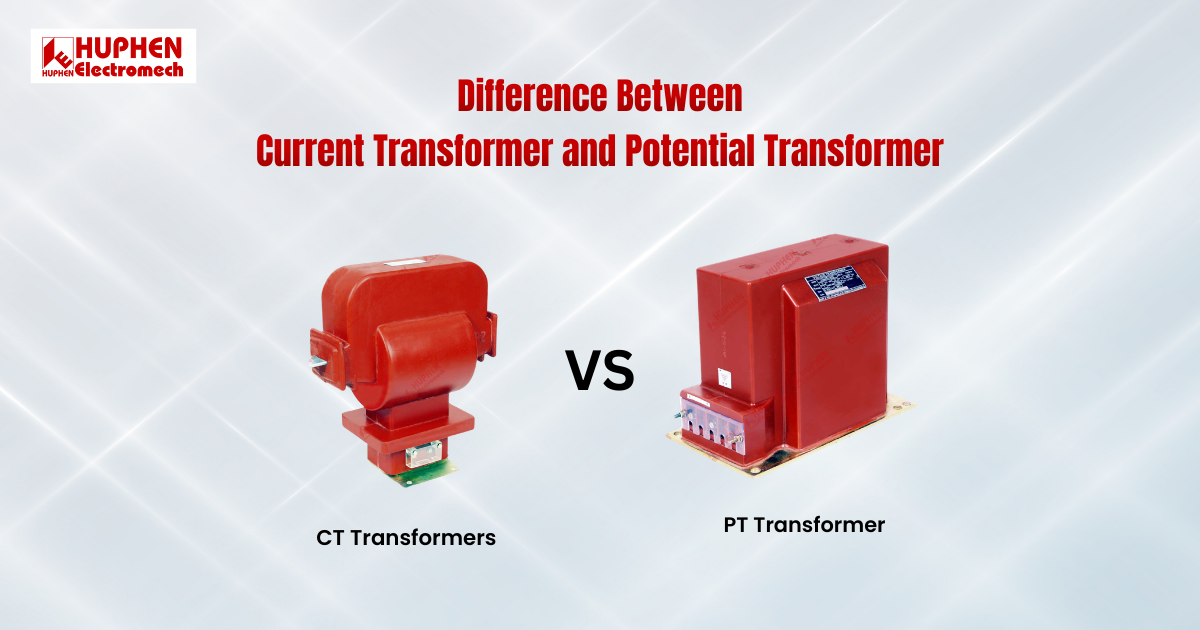

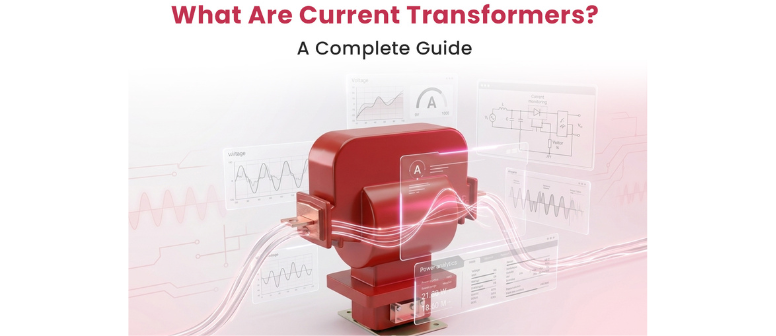
Have you ever wondered how engineers safely measure very high currents in power plants, substations, or industrial machines? Directly measuring such huge currents is dangerous and impractical. That is why electrical systems use a special device called a current transformer (CT).
If you are searching what are current transformers, this blog will give you a clear and complete understanding in simple words.
What Are Current Transformers?
A Current Transformer (CT) is a device used in electrical systems to safely reduce very high AC current into a small, proportional current, like 5A or 1A. This helps in measuring and monitoring the current without any danger. It keeps meters and relays safe from high voltage by using the principle of electromagnetic induction.
In a CT, the main high-current conductor acts as the primary winding, and it creates a smaller current in the secondary winding. This small current is then sent to devices like ammeters, protective relays, and data loggers for safe and accurate readings.
Types of Current Transformers
They come in different designs like wound, bar-type, toroidal, and split-core CTs, each made to measure current safely in various electrical setups.
1. Wound CT
These CTs have both primary and secondary windings on a magnetic core, like a small transformer. They are flexible and can be made for many different current ranges.
Useful for:
- Low and medium current measurement
- Panel meters and control panels
2. Bar-Type CT
The primary is just a solid bar passing through the core, and the secondary is wound around it. It is strong, simple, and ideal for high current.
Useful for:
- High-current switchgear
- Industrial and utility power systems
3. Toroidal (Window) CT
These CTs have a donut-shaped core with no primary winding. The main conductor simply passes through the center. They are easy to install because you don’t need to cut the primary cable.
Useful for:
- Earth leakage detection
- Residual current measurement
- Quick installation in panels
4. Split-Core CT
These are similar to toroidal CTs but can be opened and clamped around an existing conductor. No need to disconnect wires, making installation very convenient.
Useful for:
- Retrofitting in old panels
- Temporary load studies
- Energy audits
4. Dry Type HT Current Transformer
A Dry Type HT current transformer is a high-voltage current transformer that uses solid insulation (like epoxy resin) instead of oil. It safely reduces high current to a small current for meters and relays.
Useful for:
- Works in 11kV, 22kV, 33kV and other HT systems
- Safe and accurate current measurement
- Compact, lightweight, and easy to install
- Good for indoor and outdoor panels and substations
Construction of Current Transformers
Current transformers may look simple from the outside, but inside, they are made with high-precision electrical components. Their construction plays a major role in accuracy and safety.
1. Magnetic Core
The core is the heart of the CT. It is usually made from:
- Silicon steel laminations – used in general metering and protection CTs
- Permalloy or Mumetal – used where high accuracy is needed
These materials provide high magnetic permeability, which means they allow magnetic flux to pass easily. This helps in maintaining a stable ratio between the primary and secondary current.
2. Primary Winding
The primary winding of a CT is very different from that of a normal transformer. Instead of multiple turns:
- It may have only one turn, which is basically the conductor (or busbar) carrying the full system current.
- In some cases, it has a few turns (multi-turn primary) for small current measurement.
Because the primary handles the full load current, it is made with thick copper.
3. Secondary Winding
The secondary winding has several turns. This winding produces the reduced current (5A, 1A, or sometimes 0.1A) that we measure with meters or relays.
4. Insulation and Outer Body
CTs require strong insulation because their primary side may be carrying thousands of amperes. Good insulation prevents breakdown and ensures long-term durability.
5. Ratings and CT Ratio
- Common primary current ratings range from 10A to 3000A or even higher. Secondary current is usually standardized at 5A or 1A.
- The CT ratio shows how much current is stepped down.
- For example: If CT ratio = 1000/5
- Then 1000A primary becomes 5A secondary.
Working Principle of Current Transformer
The operation of a current transformer depends on the simple concept of electromagnetic induction.
1. Electromagnetic Induction
- When current flows through the primary conductor, it creates magnetic flux in the core.
- This changing flux induces a current in the secondary winding.
- The secondary current is proportional to the primary current.
2. Phasor Diagram Basics
A CT phasor diagram includes:
- Flux
- Primary and secondary induced voltages
- Excitation current (I₀)
- Magnetising component (Im)
- Working component (Iw)
Even though CTs look like power transformers, the role of excitation current is different in CTs because accuracy depends on maintaining the correct phase angle and ratio.
3. Difference from Power Transformers
- One major difference is that CT performance depends on the burden (load) connected to the secondary.
- If the burden increases too much, the error also increases.
- Also, a CT is designed to work with its secondary always closed, unlike power transformers, which can operate with an open secondary.
Applications of Current Transformer
Current transformers are widely used in:
- Energy metering (kWh meters)
- Current and power monitoring
- Protection relays (overcurrent, earth fault, differential)
- Industrial drives and control boards
- Substations and switchgear (LV, MV, HV)
- Generator and transformer protection
CTs ensure that even high currents above 100A or 1000A can be monitored safely.
Conclusion
Now you clearly understand what are current transformers and how they play a major role in making electrical systems safe, accurate, and reliable. From construction to working, types to errors, and applications to selection guidelines, CTs are essential for every modern power system.
Looking for a safe and maintenance-free CT for high-voltage systems? Dry Type HT CTs by Huphen offer accurate measurement, strong epoxy insulation, and easy installation. Perfect for 11kV to 33kV substations and industrial panels. For enquiries, call +91 9607381475 / +91 253 2381475 or email info@huphen.com.
Note: "This information is provided for informational purposes only. We are not responsible or liable for any issues arising from it."
Related Blogs

.png)